FAQ
Yoga teacher training in Rishikesh — every honest question, answered.
Eighteen years of running residential Yoga Alliance teacher trainings on the Ganges. The questions students send us most often, grouped by what you're actually trying to figure out.
In one paragraph
We are a Yoga Alliance Registered School (RYS 200 / 300 / 500, ID 329284) in Tapovan, Rishikesh, founded in 2008. Cohorts are capped at twenty to thirty students. Programs run year-round with monthly start dates. Deposits are 20–30% of the course fee. Sudhanshu Badoni leads every cohort personally, supported by six teachers across Hatha, Vinyasa, Ashtanga, pranayama, Ayurveda, and philosophy.
About the courses
How many students are there in a yoga teacher training course?
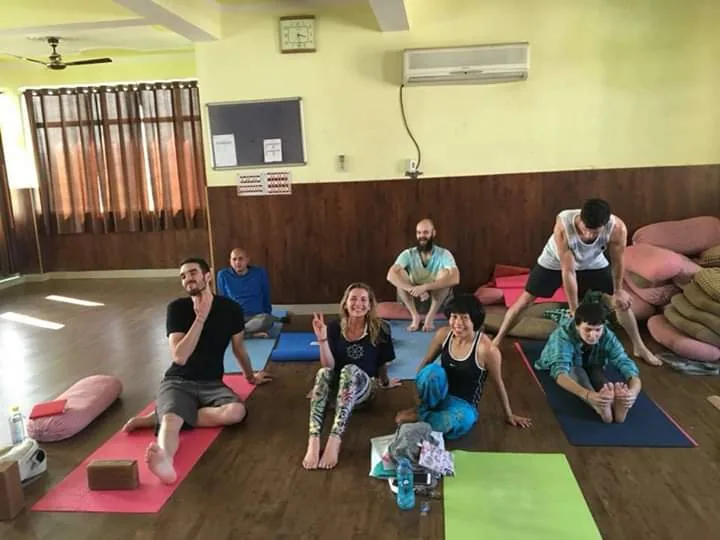
Cohorts are capped at twenty to thirty students. Small enough that every teacher knows your name, your practice, and where you need feedback.
I'm a near-beginner — will the training be too advanced?
Our 100hr and 200hr programs are designed to receive practitioners from a wide range of backgrounds. You need at least six months of regular yoga practice and a genuine intent to deepen it. The 300hr requires a valid RYT-200.
What style of yoga is taught?
The training is multi-style — primarily Hatha and Ashtanga, with Vinyasa flow, pranayama, philosophy, anatomy, and meditation woven through every day. This gives you the breadth to teach various class formats and find your own teaching voice.
What is the dress code for class?
Modest, comfortable, breathable clothing. We ask that students dress respectfully of Indian cultural norms — please avoid overly tight or revealing attire in shared spaces.
Do I need to bring my own yoga mat?
You are welcome to bring your own. We provide mats, blocks, and straps for daily use throughout the training.
When do we have free time?
Breaks, lunch, and most evenings are unstructured. Sundays are typically off — many students use them to explore Rishikesh or rest at the shala.
Can I skip a class if I need to?
Full attendance is encouraged and required for certification. If you are unwell, inform your teacher and we will make accommodations.
Can I attend with my partner?
Yes — shared accommodation is available on request when both partners book together.
Will language be a barrier if English isn't my first language?
Not at all. Our teachers use clear, simple English, and international students from every continent join every cohort.
Do I have to read any books?
Yes — a beginner-friendly reading list is provided in advance. Texts are available at the shala library during the training.
I'm pregnant. Can I attend a course?
Our trainings are physically intensive. Please consult your doctor first and contact us to discuss your specific situation — we may be able to make modifications, or recommend a future cohort.
When should I arrive and depart?
Arrive one day before the course start; courses end in the afternoon of the last day. Airport pickup from Dehradun (Jolly Grant) is available on request.
Certification & Yoga Alliance
Is Deep Yoga Wellness registered with Yoga Alliance?
Yes. We are a Registered Yoga School (RYS) with Yoga Alliance, USA — accredited for RYS 200, RYS 300, and RYS 500 (Yoga Alliance ID 329284).
How do I become a certified yoga teacher?
Complete one of our YTTCs (100, 200, 300, or 500 hour) and you will receive a certificate that allows you to register as an RYT with Yoga Alliance.
Is the certificate valid internationally?
Yes — Yoga Alliance registration is recognised in over 100 countries.
Do I need to pass exams to complete a course?
Yes. Each course includes practical and written evaluations. Certification requires you to pass both, alongside full attendance.
Can I teach in other countries with this certificate?
Yes, once you register as an RYT-200, RYT-300, or RYT-500 with Yoga Alliance.
Food & accommodation
Does the 200-hour yoga teacher training in Rishikesh include food and accommodation?
Yes. Every Deep Yoga teacher training is fully residential and all-inclusive: your course fee covers accommodation, three sattvic vegetarian meals a day, filtered water and chai, all course materials, and your Yoga Alliance certification. Accommodation, dining, and the shala share one riverside campus in Tapovan, so there is no daily commute.
How much does the 200-hour YTT cost with food and accommodation included?
The 200-hour training is $1,299 with shared accommodation or $1,499 with a private room — both include all meals, course materials, and Yoga Alliance certification. A $250 deposit secures your seat and the balance is due before arrival. There are no hidden tuition or accommodation add-ons.
What food is served during the training?
Three sattvic vegetarian meals a day, prepared fresh in the school kitchen from seasonal local produce, plus chai and filtered drinking water. Vegan, gluten-free, and other dietary needs are accommodated on request — tell us in advance so the kitchen can prepare for you.
Is everything in one place, or do students travel between the accommodation and the yoga hall?
Everything is on one riverside campus in Tapovan, Rishikesh. Your room, the dining space, and the shala where you practise are all in the same place, so your day flows from sleep to sunrise pranayama to study without any commute.
I am vegan. Will the food work for me?
Yes. Our daily meals are pure vegetarian and easily adapted to vegan diets — please let us know in advance so the kitchen can prepare accordingly.
I have diabetes / celiac disease / a kidney condition. Can you accommodate special diets?
Yes. Please inform us in advance of your dietary or medical needs. We will do our best to provide suitable meal options for your stay.
Is there clean drinking water at the school?
Yes — filtered drinking water is available at all times throughout the campus.
Can I use my phone during the course?
Phones are fine during free time. We ask students to avoid phones during classes, meditation, and meals to keep the learning environment focused.
Is there Wi-Fi?
Yes — Wi-Fi is available throughout the shala and is intended for use during your breaks and free hours.
Are there air-conditioned rooms?
Yes, air-conditioned rooms are available on request (subject to availability and an additional charge during summer months).
Health & safety
I take regular medication. Will I be able to get refills in India?
Bring enough for the full course and carry your prescription. We can recommend local clinics if you need a refill, but it is safer to arrive with what you need.
What happens if I get sick during the course?
Local clinics and hospitals are easily accessible from the shala. Our staff will assist with transport and translation if needed.
Are any vaccinations required?
None are strictly mandatory for entry. Tetanus, diphtheria, hepatitis A and B are commonly advised — please consult your doctor before travelling.
Should I worry about malaria?
Rishikesh is generally considered low-risk for malaria. Standard mosquito precautions are sensible during monsoon months.
Is it safe to eat food in India?
Meals at the school are prepared in a clean kitchen and are safe. When eating outside, stick to busy, well-reviewed places and avoid raw foods you can't peel yourself.
Travel & transport
Which airport should I fly to?
Fly into Delhi (DEL) for international arrivals. From Delhi we recommend an onward domestic flight to Dehradun (DED, Jolly Grant Airport) — a thirty-minute drive from our shala.
How do I get from Delhi to Rishikesh?
Three options: taxi (6–7 hours, ₹5,000–₹7,000 / about $60–$85 USD), train to Haridwar then taxi (~₹150–₹1,000 depending on class), or AC bus (₹500–₹1,000).
Is it safe to travel to Rishikesh on my own?
Yes — Rishikesh is one of the safest destinations in India for solo travellers. Many of our students arrive alone.
Will you help with travel arrangements when I arrive?
Yes. Airport pickup from Dehradun (DED) is available on request — confirm your flight details with us at booking and we'll have a driver waiting.
Which visa do I need?
Most international students enter India on a Tourist Visa. Our visa eligibility checker covers the procedure for 60+ countries — see /tools/visa-eligibility-checker.
What should I pack?
Comfortable yoga clothes, a towel, toiletries, notebook and pens, a reusable water bottle, a shawl or light jacket for cool mornings, any medications you need, and a power adapter (India uses Type C, D, and M plugs at 230V).
Booking & payment
How much is the booking deposit?
A non-refundable deposit secures your seat — $200 for the 100-hour, $250 for the 200-hour, $300 for the 300-hour (the 500-hour deposit is confirmed at booking). The balance is paid on arrival in Rishikesh by cash or bank transfer.
What payment methods do you accept?
Bank transfer or UPI in INR or USD equivalents. PayPal is also available for the deposit — full bank details are provided on the payment page once you've confirmed your cohort.
What is your refund policy?
The deposit is non-refundable. More than 60 days before the start date, the balance is refundable minus a small admin fee (₹5,000–10,000). Between 30 and 60 days, 50% of the total fee is refundable. Less than 30 days before, or a no-show, is non-refundable. If a medical or family emergency forces you to leave mid-course, we offer a credit toward a future cohort.
Can I change my booking after I've paid?
Yes — request changes at least two weeks before your course start date, subject to cohort availability and approval.
Can I pay the balance by card on arrival?
Yes, card payment is possible on arrival in Rishikesh. We recommend carrying a cash backup.
Still have a question we haven't covered?
Reach us directly. Real human, within 24 hours.